Most visitors head straight for the yellow villas of White Town, but the Tamil Quarter Pondicherry is where the old town’s everyday life has always happened. West of the canal that once divided the colonial city, its streets are lined with houses that have shaded verandahs and raised platforms called thinnai, carved wooden doors and temple towers rising over the rooftops.
It is busier, noisier and far larger than the French Quarter, and it shows you a very different side of Pondicherry. This guide explains how the quarter came about, what to look for in its houses, the streets worth walking and how to fit it into a day with a scooter.
In this guide
Two towns divided by a canal
Old Pondicherry was laid out on a grid of straight streets, drafted under the Dutch in the 1690s and completed by the French after 1700. The whole grid sits inside four boulevards that mark the line of the old fortifications. Through the middle runs a canal, the Grand Canal, first built for drainage.
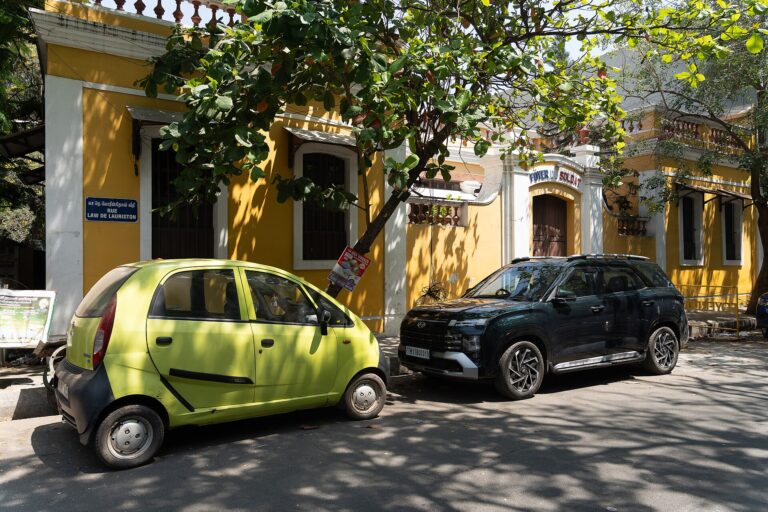
Under French rule, the canal also became a line of segregation. East of it, towards the sea, lay the Ville Blanche or White Town, where Europeans lived. West of it lay the Ville Noire, the Tamil town, home to the local Hindu, Christian and Muslim communities. Heritage writers note that the Tamil side is several times larger than the French one.
| White Town | Tamil Quarter | |
|---|---|---|
| Location | East of the canal, by the sea | West of the canal |
| Streets | Wide, quiet, tree-lined | Narrower, busier, full of shops |
| Houses | Villas behind high walls and gates | Row houses opening onto the street |
| Key features | Tall shuttered windows, courtyards hidden from view | Thinnai, verandahs on wooden posts, carved doors |
| Feel | Calm, café culture | Everyday life, markets, temples and mosques |
For the other half of the story, read our White Town walking guide.
Reading a Tamil house
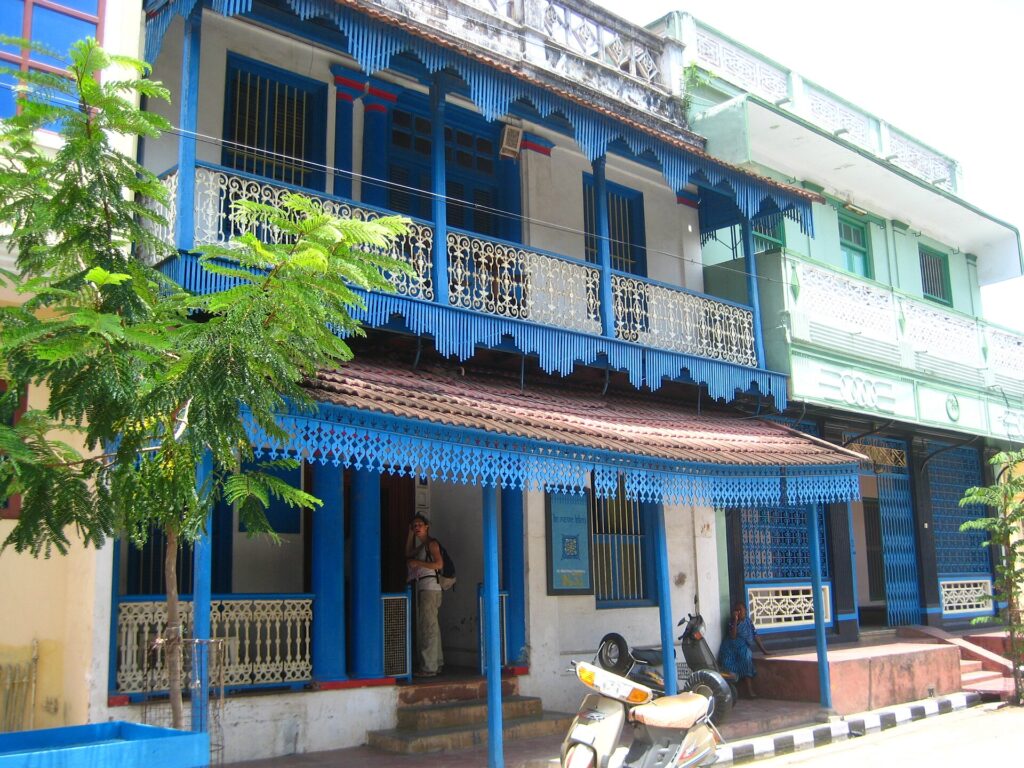
French villas turn inward, behind walls and gates. Traditional Tamil houses do the opposite: they open towards the street. Three features help you read them as you walk.
- Thinnai: a raised masonry platform or bench at the front of the house, where family members sat and neighbours or visitors were received without coming inside.
- Thalvaram: a street verandah with a sloping roof held up on wooden posts, giving shade to both the household and passers-by.
- Mutram: a courtyard at the heart of the house, often surrounded by columns and reached through a carved wooden doorway.
Some two-storey houses mix the two traditions, with a Tamil ground floor and a French-style upper floor with balustrades. This blend, often called Franco-Tamil architecture, is one of the special things about the Tamil Quarter Pondicherry. INTACH Pondicherry, which has documented the town’s heritage buildings since the late 1980s, describes how the two styles influenced each other.
Tip: These are private homes. Admire them from the street, and never sit on a thinnai or step inside without being invited.
Streets worth walking in the Tamil Quarter Pondicherry
Within the Tamil town, different communities lived in different areas: the Hindu streets to the north, Christian areas in the west and centre, and the Muslim quarter in the south. Each has its own look.
Vysial Street
Vysial Street, also called Rue Calve Subraya Chetty, is the best-known street for traditional houses, particularly the stretch between Mission Street and MG Road. It was historically home to the Chettiar merchant community, and many of its houses still have their thinnai and wooden-pillared verandahs.
The Muslim quarter
In the south-western part of the grid, streets such as Mullah Street and Cazy Street hold well-preserved Tamil houses, many brightly painted and more elaborately decorated. The Meeran Mosque and the Jama Masjid in this area are among the oldest places of worship in the town.
Temple streets in the north
The northern Hindu streets are dotted with temples. Look for the colourful gopuram of the Kamatchi Amman temple, and the Perumal and Isvaran temples along Gandhi Street. The Goubert Market, the main bazaar, sits where the Hindu and Christian areas meet, and the Sunday market fills MG Road once a week; see our Sunday market guide.
Manakula Vinayagar temple
The town’s most famous temple, dedicated to Ganesha as Manakula Vinayagar, stands just east of the canal, a few minutes’ walk from the beach road and close to the Sri Aurobindo Ashram. It predates French rule, and according to its Wikipedia entry it survived attempts to remove it during Dupleix’s time because of strong local protest.
Inside, look for the painted ceilings and the golden chariot, made of teak covered in gilded copper, which first ran in 2003 and is taken around the outer streets once a year on Vijayadashami. Many older guides mention Lakshmi, the temple elephant who blessed visitors; she died in November 2022, deeply mourned by the town.
- Remove footwear before entering and dress modestly.
- Expect queues at weekends, festivals and on auspicious days.
- Follow signs on photography inside the temple.
- Timings can change; check locally before you go.
Planning your visit
The Tamil Quarter Pondicherry is best explored on foot, early in the morning or in the late afternoon, when the streets are cooler and the light is soft on the coloured walls. Park your scooter at a marked two-wheeler area near the edge of the old town, then walk.
- Start at Manakula Vinayagar temple in the morning.
- Cross the canal westwards and walk Vysial Street between Mission Street and MG Road.
- Head north through the temple streets, then back via the Goubert Market.
- End in White Town for lunch or coffee, comparing it with the Tamil Quarter Pondicherry streets you have just walked.
INTACH Pondicherry runs guided heritage walks of both the Tamil and French towns on request, for a small fee; contact its office for details. Streets in the old town are narrow and some are one-way, so read our traffic rules guide before you ride in, and see the 2-day Pondicherry itinerary for how this walk fits a longer trip.
Rent a scooter for the old town
A light scooter is ideal for reaching the old town, parking and then exploring on foot. Choose a Honda Activa or Suzuki Access 125 from bike rental in Pondicherry or bike rental in Auroville, on hourly, daily, weekly or monthly plans. Bring your original photo ID and a ₹500 cash deposit; the helmet is free, delivery is available, and please return the scooter with the same fuel level.
Prefer a guided day? Our sightseeing tours cover the heritage town. Message us on WhatsApp at +91 96265 65138 to book.
Frequently asked questions
Where is the Tamil Quarter in Pondicherry?
It lies west of the old canal that runs north to south through the centre of the old town. White Town, the French Quarter, lies east of the canal towards the sea.
What is a thinnai?
A thinnai is a raised platform or bench at the front of a traditional Tamil house, where family members sat and visitors were received without entering the home.
Which street has the best Tamil houses?
Vysial Street, also called Rue Calve Subraya Chetty, especially between Mission Street and MG Road, is the best-known. Mullah and Cazy Streets in the Muslim quarter are also worth walking.
Is Manakula Vinayagar temple in the Tamil Quarter?
It stands just east of the canal, near the beach road and the Sri Aurobindo Ashram, so it is a short walk from the Tamil Quarter’s streets.
Are there guided walks of the Tamil Quarter?
INTACH Pondicherry runs heritage walks of the Tamil town on request for a small fee. Contact its office for current details.
Need a bike, scooter or taxi?
Tell us your dates on WhatsApp – we reply fast and keep your ride ready.