An Arikamedu scooter ride takes you about 4 km south of Pondicherry town to one of the most important archaeological sites in South India. Some two thousand years ago, ships and traders gathered at this bend in the Ariyankuppam River, and pottery from the Mediterranean ended up buried in its soil beside beads made on the spot.
Today the site is quiet, half-wild and easy to miss. That is part of its charm, but it also means you should know what you are looking at before you go. This guide explains the history, what is left to see, how to ride there from town or Auroville, and where to find the objects that made Arikamedu famous.
In this guide
Why Arikamedu matters
Arikamedu sits in the Ariyankuppam area, on the bank of the Ariyankuppam River, also called the Virampattinam River, which is a northern outlet of the Gingee River before it meets the Bay of Bengal. A river bend like this gave sea-going boats a sheltered place to load and unload.
Excavations show that it was a busy port and craft town in the early centuries of the common era. Goods and ideas moved between the Tamil coast and the Mediterranean world, and Arikamedu is one of the clearest places where archaeologists have found the physical evidence of that trade.
A short history of the digs
French residents of Pondicherry noticed old bricks being taken from the site as early as the 18th century. In 1937 the French scholar Jouveau-Dubreuil bought antiquities, including gems, from local children and became convinced the place had Roman links.
The first scientific excavation came in 1945, led by the British archaeologist Sir Mortimer Wheeler. He described Arikamedu as an Indo-Roman trading station and dated its foreign trade to roughly the 1st century BCE and the 1st–2nd centuries CE. Jean-Marie Casal dug here again from 1947 to 1950.
From 1989 to 1992 a team led by Vimala Begley and K. V. Raman ran new seasons of excavation. Their work showed that the settlement was older and lasted far longer than Wheeler thought, from around the 2nd century BCE to perhaps the 7th or 8th century CE.
| Period | Who | Key point |
|---|---|---|
| 1937 | G. Jouveau-Dubreuil | Collected gems and antiquities; argued for Roman contact |
| 1945 | Mortimer Wheeler | First scientific excavation; “Indo-Roman” trading station |
| 1947–1950 | Jean-Marie Casal | Further excavation, including nearby burial sites |
| 1989–1992 | Vimala Begley and K. V. Raman | Revised the dates; settlement lasted many centuries |
The finds: amphorae, Arretine ware and beads
Three kinds of find made Arikamedu famous. Each tells part of the story of a port where Indian and foreign goods met.
- Amphorae: pieces of tall two-handled storage jars from the Mediterranean, used to carry goods such as wine and oil. Fragments turn up even in the lowest layers, which suggests contact from the start.
- Arretine ware: fine red-glazed tableware that Wheeler linked to Arezzo in Italy. It helped him date the site.
- Beads: glass and semi-precious stone beads. Begley’s team argued that Arikamedu was a major maker of the small glass beads now called Indo-Pacific beads, which travelled widely across Asia.
- Other objects: rouletted ware pottery, gems, lamps and glass, plus later items such as Chinese celadon and Chola coins.
It is worth keeping one point in mind. The foreign pottery proves trade with the Mediterranean world, not that Romans founded or ran the town. Most researchers now see Arikamedu as a local port and bead-making centre that traded with many partners.
What you see at Arikamedu today
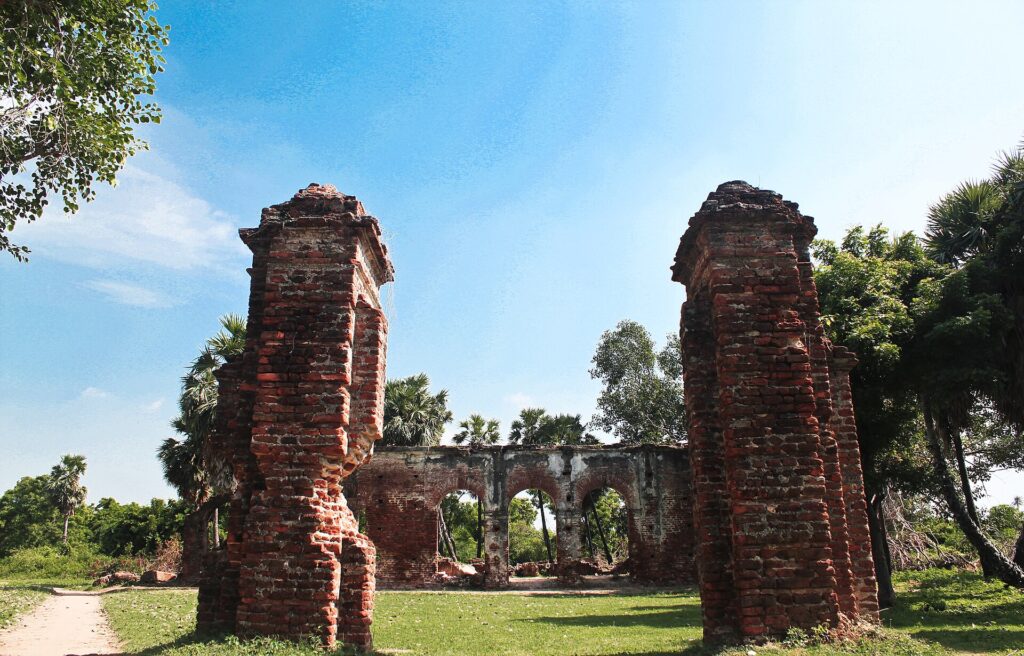
Be ready for something modest. The excavation trenches have long been filled in, and there is no site museum. What stands out are the brick ruins of an 18th-century French Jesuit mission house: two tall gateposts, a row of arches and broken walls among palm and neem trees.
Those ruins are far younger than the ancient port, but they make a lovely, slightly eerie scene, especially in the soft light of early morning. Behind them the ground slopes towards the river. Cattle and goats often graze on the grass, and you may have the place to yourself.
ASI protection
Arikamedu is protected by the Archaeological Survey of India as an early historic site of national importance, under the Puducherry sub-circle of the ASI Chennai Circle. You can see it in the ASI’s list of Puducherry monuments and sites. Plans for a site museum and better display have been discussed for years, so facilities may change.
Tip: This is a protected site. Do not dig, pick up pottery sherds or climb on the ruins. Taking anything away is against the law and damages the record for everyone.
Planning your Arikamedu scooter ride
The best time for an Arikamedu scooter ride is the cooler season from about November to February, though the short distance makes it possible all year if you avoid the midday heat.
From Pondicherry town, head south out of the centre towards Ariyankuppam on the Cuddalore road, cross the river, and follow your phone map to Arikamedu. The last stretch is a narrow lane and dirt path, and signboards have been poor, so keep Google Maps open. The whole ride is short and easy on a scooter.
From Auroville the ride is longer, since you first come down towards Pondicherry and then go south through or around town. Check the current route and traffic on your map before you set out. In our view a Honda Activa or Suzuki Access 125 is all you need; the path near the site suits a light scooter better than a heavy bike.
Tips for the visit
- Go early in the morning or late afternoon, when it is cooler and the light is best for photos.
- Wear covered shoes; the ground is uneven and can be thorny or muddy.
- Carry water and mosquito repellent, as there are no shops on the site itself.
- Park the scooter where it does not block the lane, and lock it.
- After heavy rain the path can be muddy; read our monsoon riding guide if you visit between October and December.
- Plan to be back on the main road before dark, as the lane is unlit.
An Arikamedu scooter ride fits easily into half a day. You can pair it with the beaches and backwaters south of town, or with a slow afternoon in the old French Quarter; our White Town walking guide covers that part of town.
Where to see the Arikamedu finds
The objects themselves are scattered across several museums, but the easiest place to see them is the Pondicherry Museum (Puducherry Museum) on St Louis Street in the old French Quarter. Its archaeology section displays material from Arikamedu, including pieces of amphorae and pottery. Wheeler himself first recognised Roman pottery among items kept in this museum.
It makes sense to visit the museum before or after your Arikamedu scooter ride, so the empty site is easier to picture. Museum timings, weekly closing days and entry fees can change, so check them locally at the time of your visit. Photography rules inside the museum may also apply.
Rent a scooter or book a taxi
Our scooters are ideal for short heritage rides like this one. Choose a Honda Activa or Suzuki Access 125 from bike rental in Pondicherry or bike rental in Auroville, on hourly, daily, weekly or monthly plans. Bring your original photo ID and a ₹500 cash deposit; the helmet is free, delivery is available, and please return the scooter with the same fuel level.
Prefer not to ride? Our taxi pickup and drop and sightseeing tours can take you to Arikamedu and the museum. Message us on WhatsApp at +91 96265 65138 to book either option.
Frequently asked questions
How far is Arikamedu from Pondicherry?
Arikamedu is about 4 km from Pondicherry, on the Ariyankuppam River south of town. On a scooter it is a short, easy ride.
Is there an entry fee at Arikamedu?
We are not aware of a ticket counter at the site, which is an open ASI-protected area. Rules can change, so follow any notices or staff you find there.
What will I see at Arikamedu today?
Mainly the brick ruins of an 18th-century Jesuit mission house, open ground and the river. The ancient trenches have been filled in and there is no site museum.
Where can I see the Roman amphorae from Arikamedu?
The Pondicherry Museum in the town centre displays finds from Arikamedu, including amphora fragments and pottery. Other pieces are in museums elsewhere in India.
Who excavated Arikamedu?
Mortimer Wheeler led the first scientific excavation in 1945, followed by Jean-Marie Casal (1947–1950) and Vimala Begley with K. V. Raman (1989–1992).
Need a bike, scooter or taxi?
Tell us your dates on WhatsApp – we reply fast and keep your ride ready.