A Gingee fort day trip takes you inland from the coast to one of the most dramatic sights in Tamil Nadu: three rocky hills crowned with citadels and linked by kilometres of granite wall. Gingee, also written Senji or Chenji, sits in Villupuram district, close enough to Pondicherry and Auroville for an easy day out.
This guide covers the route, whether to go by taxi or on a rented motorbike, a short history, how hard the Rajagiri climb really is, timings and tickets, and how to deal with the monkeys. For more ideas, see our list of day trips from Pondicherry.
In this guide
Gingee Fort in brief
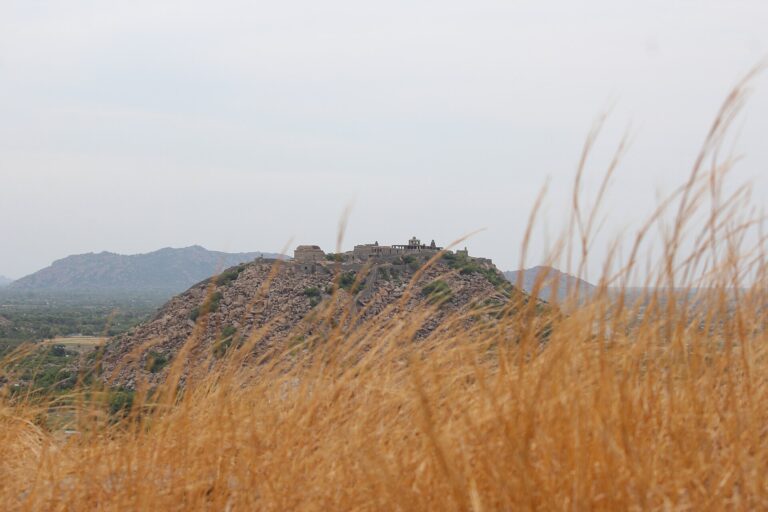
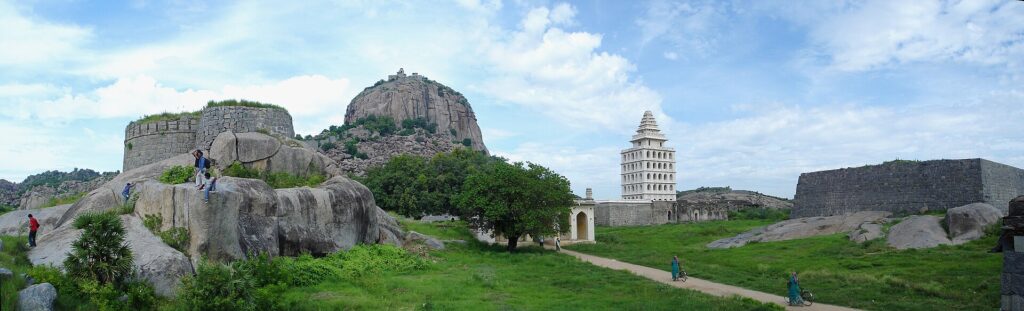
The fort complex spreads across three hills: Rajagiri, the highest at about 800 feet, Krishnagiri to the north, and the smaller Chandrayan Durg (also called Chakkili Durg). Walls around 13 km long tie the hills together, enclosing palaces, granaries, temples, tanks and parade grounds on the plain below.
The Archaeological Survey of India (ASI) protects the fort, which was declared a monument of national importance in 1921. In July 2025 UNESCO inscribed it on the World Heritage List as part of the Maratha Military Landscapes of India. It is the only one of the twelve forts in that listing that lies outside Maharashtra.
A short history
Local tradition credits a chieftain called Ananda Kon with fortifying the hills around 1200 AD. Under the Vijayanagara empire the fort grew into the seat of the Gingee Nayaks, who built much of what you see on the plain. The Bijapur Sultanate took it in the mid-17th century, and in 1677 Shivaji captured Gingee for the Marathas.
Later the Mughals seized it after a long siege in 1698, and it passed to the Nawabs of Arcot. The French held it from 1750, and it was surrendered to the British in 1761. Its strength earned it nicknames like “the Troy of the East”, a phrase the British are said to have used.
Distance and route from Pondicherry
Gingee town is roughly 65 km from Pondicherry by road. Most drivers head north-west to Tindivanam and then turn west on the road towards Tiruvannamalai; the forts stand on either side of that road just past Gingee town. Allow about 1.5 hours each way by car, more on weekends or market days.
From Auroville the drive is similar, as you join the Tindivanam road without going through Pondicherry town. Google Maps will show the current fastest route; check it on the morning of your trip.
| Taxi | Rented motorbike | |
|---|---|---|
| Who it suits | Families, first-timers, anyone who wants to save energy for the climb | Experienced riders comfortable with highway traffic |
| Comfort | Air-conditioned rest after a hot climb | Sun and heat both ways; you ride home tired |
| Flexibility | Driver waits while you explore | Stop wherever you like |
| Our suggestion | The easier choice for most visitors | A Pulsar, FZ or Apache rather than a scooter |
In our view, a taxi is the sensible choice for most people. The climb itself is tiring, and riding 65 km back in the afternoon heat after it is not much fun. If you do ride, read our traffic rules and helmet guide first and take regular breaks.
The Rajagiri climb: what to expect
Rajagiri is the climb most visitors come for. A path of stone steps, gateways and steep sections leads up through several fortified gates to the citadel, where a small bridge crosses a deep natural chasm. At the top you find a small temple, ruined fort buildings and wide views over the plain and the other two hills.
Visitor accounts give very different step counts, so we won’t quote one. What they agree on is that the steps are uneven, some stretches are steep, and there is little shade higher up. A reasonably fit person should allow around 3 to 4 hours for Rajagiri plus the main buildings on the plain.
Who should skip the summit
The full climb is not a good idea for small children, older visitors with mobility problems, or anyone with knee or heart trouble. They can still enjoy the lower fort: the Kalyana Mahal with its tall tower, the granaries, the elephant tank and the temples around the plain.
Best start time
Start as early as the gates allow. The rock heats up quickly, and by late morning the upper steps can be very hot. On a Gingee fort day trip from the coast, leaving Pondicherry or Auroville around 7 am usually gets you to the gate close to opening time.
Tip: Do not start the Rajagiri climb late in the afternoon. Visitors report that entry to the hill is stopped well before closing time, and you need daylight to come down safely.
Timings and tickets
Gingee Fort is a ticketed ASI monument, and the ASI Chennai Circle lists the ticket as covering both Rajagiri and Krishnagiri. Opening is generally given as morning to 5 pm, but sources differ on the exact hours and on when climbing entry closes.
Ticket prices for Indian and foreign visitors have changed over the years, with foreign visitors paying more. Children under 15 have usually had free entry at ASI sites. Fees and timings are correct only at the time of writing, so check at the ticket counter or with the ASI before you go, and carry some cash.
Monkeys, safety and what to carry
Monkeys live all over the hills and are bold around visitors. They grab food, plastic bags and loose items. Keep snacks out of sight in a zipped bag, don’t feed them, don’t stare at or chase them, and give a group with babies plenty of room.
On the steps, watch your footing, especially coming down, and keep to marked paths away from cliff edges. Avoid the climb after heavy rain, when the rock can be slippery. Let someone know your plan if you go alone.
- Plenty of drinking water: at least 1.5 to 2 litres per person for the climb
- Light snacks in a closed bag, eaten away from the monkeys
- A hat, sunglasses and sunscreen
- Shoes with good grip; sandals are a poor choice on the steps
- A small backpack, so both hands are free
- Cash for tickets, parking and refreshments
- A light towel and a spare T-shirt for the ride home
Planning your Gingee fort day trip
November to February is the most comfortable season, with cooler mornings. Summer days from about April to June are very hot on the rock. During the north-east monsoon, roughly October to December, check the forecast; see our guide to riding in the monsoon if you are on two wheels.
- Leave Pondicherry or Auroville early, with breakfast packed or on the way.
- Buy tickets and climb Rajagiri first, while it is cool.
- Rest, eat lunch in Gingee town, and drink plenty of water.
- Walk the lower fort and, if you still have energy, look at Krishnagiri.
- Head back in the afternoon so you are home before dark.
Our sister site has a detailed page on Gingee Fort: the Rajagiri climb, timings and history, worth reading before your Gingee fort day trip. Pondicherry Holidays also plans longer tours if you want to add other places inland.
Book your taxi or bike
Our taxi service covers pickup and drop and sightseeing trips, which is the easiest way to make a Gingee fort day trip and still have energy for the climb. See taxi pickup and drop and our sightseeing tours and day trips.
Experienced riders can rent a Bajaj Pulsar, Yamaha FZ or TVS Apache on bike rental in Pondicherry, on hourly, daily, weekly or monthly plans. You need your original photo ID and a ₹500 cash deposit; the helmet is free, and please return the bike with the same fuel level. Message us on WhatsApp at +91 96265 65138 to book either option.
Frequently asked questions
How far is Gingee Fort from Pondicherry?
Gingee is roughly 65 km from Pondicherry by road, usually via Tindivanam. Plan on about 1.5 hours each way by car.
How long does the Rajagiri climb take?
Allow around 3 to 4 hours for Rajagiri and the main buildings on the plain. Fitness, heat and how often you stop make a big difference.
Can I visit Gingee Fort without climbing?
Yes. The lower fort has the Kalyana Mahal, granaries, tanks and temples on the flat ground, and you can see the citadels from below.
What are the timings and ticket prices?
Gingee is a ticketed ASI monument, generally open from morning until 5 pm, with climbing entry stopping earlier. Prices and hours change, so check at the counter or with the ASI before you go.
Is it safe to ride to Gingee on a rented scooter?
Only for experienced riders comfortable on highways. A geared bike is better than a scooter for the distance, and most visitors will find a taxi more relaxing after the climb.
Need a bike, scooter or taxi?
Tell us your dates on WhatsApp – we reply fast and keep your ride ready.